
 English
Views: 0 Author: Site Editor Publish Time: 2026-06-28 Origin: Site


Formulating personal protective equipment requires a delicate balance. Manufacturers must weigh raw material capabilities against strict safety compliance mandates. 400 Denier (400D) Ultra-High Molecular Weight Polyethylene (UHMWPE) serves as a critical baseline material. It is essential for manufacturing gloves requiring high tactile sensitivity alongside robust mechanical protection.
However, not all 400D yarns perform equally under the ANSI/ISEA 105 testing framework. The ASTM F2992 test exposes weaknesses in inferior materials quickly. Inconsistent yarn tenacity or poor composite blending often leads to failed compliance tests. These failures trigger costly batch rejections and increase manufacturer liability. You need a reliable material foundation to avoid these pitfalls.
This article provides a strict, evidence-based framework for evaluating these materials. You will learn how to properly assess, blend, and source the correct yarn. Implementing these strategies ensures verifiable ANSI compliance. It also streamlines your manufacturing efficiency and protects your end-users.
Dexterity vs. Protection: 400D UHMWPE is optimal for 13-gauge and 15-gauge knitting, naturally yielding ANSI A2 to A3 cut resistance before engineered blending.
Compliance Validation: Fiber selection must be validated against the ASTM F2992 TDM-100 test method; standalone 400D cannot reach extreme high-cut levels (A5+) without composite cores (e.g., fiberglass, steel).
Manufacturing Realities: Lot-to-lot consistency in fiber tenacity and elongation is more critical to long-term profitability than baseline material cost.
Supplier Diligence: Require independent lab data and transparent traceability from fiber suppliers before integrating their yarn into your glove production lines.
Selecting the right denier is the first step in designing protective hand gear. The 400D variation represents the industry sweet spot for lightweight, breathable apparel. It perfectly balances physical strength and human ergonomics. Heavier yarns, like 800D or 1000D, offer massive durability but severely reduce tactile feedback. Workers wearing 800D gloves struggle to handle small screws or manipulate touchscreen devices. Conversely, 200D yarns offer extreme high dexterity but sacrifice baseline protective capabilities. They tear easier under moderate industrial stress.
You can clearly see why 400D dominates seamless knitting floors. It feeds perfectly into standard 13-gauge and 15-gauge machines. This compatibility produces a "second-skin" fit. Workers are more likely to wear protective gear consistently when it feels natural.
We must define the realistic baseline performance limits of pure 400D materials. Without additives or hard cores, these yarns generally cap at lower-to-mid ANSI levels. You can reliably achieve ANSI A2 or A3 ratings using pure yarn. Achieving anything higher requires advanced blending techniques. Knowing this limitation prevents over-promising on performance metrics.
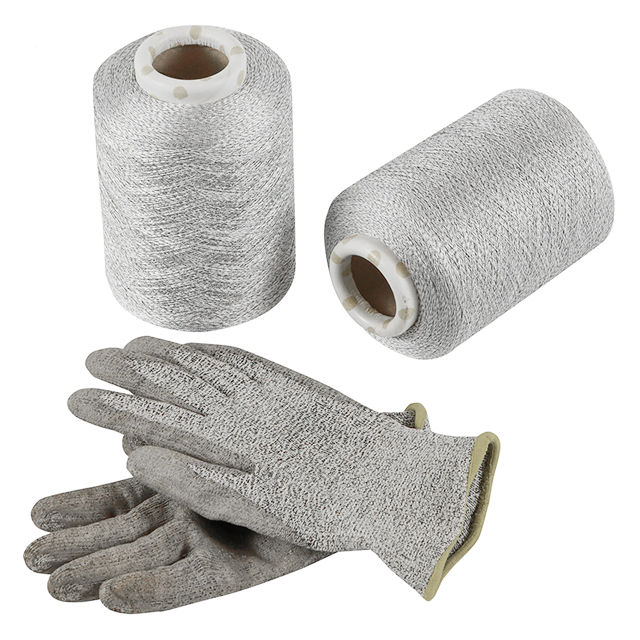
A successful fiber choice must pass specific gram-weight cut thresholds. It must also maintain structural integrity during the polymer coating process. Gloves are frequently dipped in polyurethane (PU), sandy nitrile, or latex. The yarn must survive these chemical baths and subsequent heat-curing ovens. Choosing premium UHMWPE fiber for Gloves ensures the structural matrix remains stable throughout these harsh manufacturing phases.
Understanding how laboratories test these materials helps you source better yarn. The ANSI/ISEA 105 standard relies heavily on the ASTM F2992 test method. This method uses a Tomodynamometer (TDM-100) machine. The machine drags a straight-edge blade across the fabric sample. It measures the precise grams of load required to cut through the material at a 20mm distance. The chosen yarn must demonstrate predictable load-bearing capacity during this process.
Tenacity and molecular weight are your primary indicators of success. Higher molecular weight typically yields higher tensile strength. The polymer chains are longer, making them harder to sever. Buyers should ignore generic "high strength" marketing claims. Instead, look for specific tenacity ratings measured in cN/dtex. A proper UHMWPE fiber for Cut-resistant applications will proudly display these metrics on its technical data sheet.
You must also evaluate elongation at break and creep resistance. Elongation measures how much the material stretches under stress before snapping. Too much elongation causes gloves to deform over time. They become baggy and unsafe around rotating machinery. Too little elongation makes the fabric brittle. The stitches snap during the donning and doffing process. Creep resistance ensures the material holds its shape under continuous tension.
Thermal stability often gets overlooked during the sourcing phase. Coating curing ovens routinely exceed 100°C. Polyethylene naturally has a lower melting point compared to aramid fibers. If the yarn lacks adequate thermal stability, the heat degrades its protective properties. The final product might look fine but will fail the TDM-100 test drastically.
Specification Metric | Ideal Range / Characteristic | Impact on Glove Manufacturing |
|---|---|---|
Tenacity (cN/dtex) | > 35 cN/dtex | Determines baseline cut and tear resistance. Higher is better. |
Elongation at Break (%) | 3% - 4% | Prevents glove deformation while allowing comfortable flexibility. |
Thermal Stability | Stable up to 130°C | Survives PU and Nitrile curing ovens without losing tensile strength. |
Yarn Evenness (U%) | < 2% variance | Ensures smooth running on 13g/15g knitting machines. Prevents jams. |
Request independent lab test reports rather than internal factory data.
Test multiple cones from different production lots to verify consistency.
Simulate oven temperatures on raw yarn samples before knitting full batches.
Many buyers operate under a common misconception. They believe pure polyethylene yarns can achieve maximum ANSI cut levels. This is physically impossible under current material science constraints. To reach A4, A5, or even A9 ratings, you must engineer composite structures.
Engineered yarns combine the soft, flexible nature of polyethylene alongside hard, abrasive cores. These composite structures trick the TDM-100 blade. The blade hits the hard core, dulls slightly, and requires more weight to penetrate the fabric.
Fiberglass core blending represents the most cost-effective method to bump a base yarn into the A4 range. The manufacturing process wraps the soft 400D outer layer around a microscopic glass filament. However, this method carries inherent risks. Glass fibers can fracture over time. These micro-fractures poke through the soft outer layer and cause skin irritation or contact dermatitis. You must ensure the wrapping process is incredibly dense to mitigate this risk.
Stainless steel wire blends become necessary for achieving A5 to A9 ratings. These heavy-duty applications require serious engineering. Wrapping a soft polymer around a stiff steel core challenges even the best spinners. If the tension is wrong, the steel wire loops out. This creates a defective, uncomfortable product. Properly executing this blend creates an impenetrable barrier against sharp edges.
It is crucial to understand the difference between abrasion and cut resistance. The composite core provides the necessary cut resistance. However, the outer sheath handles the friction. Using a premium 400D UHMWPE fiber for cut-resistant gloves directly determines your EN 388 or ANSI abrasion scores. The outer material absorbs the rubbing, scraping, and daily wear. A weak outer layer exposes the core quickly, ruining the glove.
Translating theoretical material specs into daily manufacturing realities reveals several hidden risks. Even the strongest yarn fails if it cannot run smoothly on your equipment. You must anticipate these operational hurdles before committing to a massive order.
Knitting Machine Compatibility: Modern seamless knitting machines run at high speeds. 13-gauge and 15-gauge needles are delicate. Inconsistent yarn diameter causes catastrophic machine jams. Thick spots catch in the needle hooks, breaking them instantly. This drives up defect rates and maintenance downtime.
Spin Finish Inconsistencies: Fiber suppliers apply chemical treatments called spin finishes during extrusion. This reduces static and friction. If the finish is applied unevenly, the yarn tension fluctuates during knitting. The resulting fabric will show visible banding or inconsistent stitch density.
Coating Adhesion Failures: UHMWPE possesses a naturally low coefficient of friction. It is inherently slick. This slickness repels liquids, making polymer dipping difficult. Evaluate how the supplier treats the yarn specifically for adhesion. If the surface energy is too low, your polyurethane or sandy nitrile dips will peel, flake, or bubble after curing.
Dyeing Limitations: Polyethylene lacks molecular receptor sites for traditional textile dyes. Acknowledge the difficulty of coloring these materials. Most high-performance yarns are standard white or dope-dyed black. Attempting to surface-dye these gloves usually results in poor colorfastness. The color bleeds onto the user's hands.
UV Degradation: Extended exposure to direct sunlight breaks down the polymer chains. If the formulation lacks UV stabilizers, the gloves will lose their protective properties over several months of outdoor use. You must account for environmental exposure in your product design.
To mitigate these risks, quality control teams must operate proactively. Do not wait for the final glove inspection to catch material flaws. Monitor the incoming raw material tension constantly. Inspect the needle beds daily for unusual wear patterns caused by abrasive composites.
Your supply chain is only as strong as its weakest link. Selecting a vendor based solely on initial quote estimates is a dangerous game. You need a rigorous sourcing framework to filter out unreliable producers. Quality fade is a real phenomenon where initial samples pass, but bulk shipments slowly degrade in quality.
Lot-to-lot consistency audits remain the most critical metric for manufacturers. A mere 5% variance in tenacity between batches can cause a final product to fail an ANSI compliance audit. When safety inspectors pull your product from the field and test it, that 5% drop results in legal liability. Demand continuous statistical process control (SPC) data from your partners.
Always demand specific, verified documentation before onboarding a new vendor. Do not accept marketing brochures as proof of performance. You must collect the following records:
Third-party TDM-100 test results performed on knitted fabric samples, not just raw yarn.
Current ISO 9001 certification for the exact manufacturing facility producing your order.
REACH and RoHS compliance certificates confirming the chemical safety of their spin finishes.
Implementing a strict pilot testing protocol saves thousands of dollars. Never transition straight from a 1-kilogram sample to a full container load. Advise your production team to run a small-batch trial first. Knitting 500 pairs provides enough data to evaluate machine efficiency. It allows you to test coating adhesion across multiple dipping racks. Finally, it gives you enough physical samples to send out for final ANSI laboratory validation.
Evaluation Phase | Action Item | Pass/Fail Criteria |
|---|---|---|
Phase 1: Document Review | Request TDS, SDS, and ISO certificates. | Must provide valid third-party lab results. |
Phase 2: Sample Testing | Knit 1kg cone on target machine gauge. | Zero needle breaks; consistent stitch density. |
Phase 3: Dip Compatibility | Process sample panels through coating lines. | No flaking, bubbling, or delamination after curing. |
Phase 4: Pilot Production | Run 500-pair trial and send to ANSI lab. | Maintains targeted A-level rating across 5 random samples. |
Selecting 400D UHMWPE material is a complex balance of mechanical specifications, blending compatibility, and strict vendor vetting. You cannot isolate one variable without affecting the others. High tenacity means nothing if the yarn constantly jams your knitting machines. Excellent machine runability is useless if the final fabric fails the ASTM F2992 test.
We strongly recommend avoiding vendors selling on price alone. The risks of product failure far outweigh initial savings. Prioritize lot-to-lot consistency and verified testing data. This diligent approach ensures your products legally and safely meet ANSI/ISEA 105 mandates.
Your immediate next steps involve active validation. Request technical data sheets (TDS) and safety data sheets (SDS) from prospective suppliers today. Order 1-kilogram sample cones for immediate machine trials. Send the resulting knitted panels to an independent lab. Building a reliable protective equipment brand starts with securing an uncompromising raw material foundation.
A: Generally, no. Pure 400D material typically reaches ANSI A2 or A3. Achieving A4 or higher reliably requires engineering the yarn with an abrasive or hard core, such as fiberglass or stainless steel.
A: HPPE (High-Performance Polyethylene) is a broader, sometimes less regulated term. True Ultra-High Molecular Weight Polyethylene refers to a polymer with an extremely high molecular mass, offering superior strength-to-weight ratios and verified consistency.
A: 400 Denier is lightweight enough to be knit on 13-gauge or 15-gauge machines, providing a "second-skin" feel. It offers significantly higher tactile sensitivity compared to heavier yarns like 800D, while maintaining strong baseline abrasion and protective resistance.