
 English
Views: 0 Author: Site Editor Publish Time: 2026-10-06 Origin: Site


Specifying protective systems for an active fleet introduces a harsh physical reality. You must constantly balance ballistic survivability against vehicle mobility and available payload capacity. Pushing a platform past its Gross Vehicle Weight Rating (GVWR) creates severe mechanical liabilities. Overloaded vehicles suffer from increased stopping distances, sluggish acceleration, and dangerous rollover risks. In high-threat scenarios, an immobile vehicle quickly becomes a fatal trap.
Today, three primary materials dominate modern up-armoring: ballistic steel, ceramic composites, and Ultra-High-Molecular-Weight Polyethylene (UHMWPE). Each behaves radically differently under ballistic stress. Some materials shatter incoming projectiles. Others trap them through friction. Some purposefully sacrifice their own structural integrity to dissipate kinetic energy.
Our objective is straightforward. We want to provide fleet managers, security directors, and procurement officers with a rigorous, physics-based breakdown of these materials. Understanding how they react under fire drives accurate decision-making. We will explore material mechanics, operational advantages, and implementation risks to help you specify the correct Vehicle Armor for your exact mission profile.
Steel offers the highest multi-hit capability and lowest cost but severely penalizes vehicle payload and requires mandatory spall mitigation.
Ceramic defeats armor-piercing (AP) threats by sacrificing itself (shattering) to dissipate energy, requiring strategic placement for high-threat zones.
UHMWPE provides the lightest weight-to-protection ratio, preserving vehicle mobility, but requires more physical volume (thickness) and has specific thermal limitations.
The most effective modern vehicle armor systems are rarely monolithic; they utilize hybrid compositions to balance weight, cost, and threat defeat.
Before selecting a specific material, teams must establish a rigorous evaluation framework. Armoring a vehicle is never a one-size-fits-all process. It requires careful alignment between anticipated threats and the mechanical limitations of your specific chassis.
You must align your material selection directly with anticipated threats. Haphazardly adding armor creates unpredictable results. Instead, rely on standardized ballistic frameworks.
CEN 1063 (B4-B7): European standards frequently used for commercial vehicles. B4 covers handguns, while B6 and B7 dictate protection against high-velocity rifle rounds.
VPAM: A highly precise standard evaluating the entire vehicle system rather than just isolated materials.
NIJ: The National Institute of Justice standard. While heavily used for personal body armor, its threat levels frequently guide vehicle material selection.
STANAG 4569: A NATO standard defining protection levels for occupants of logistic and light armored vehicles against kinetic energy, artillery, and IED strikes.
Pinpoint your required threat level first. A vehicle operating in urban areas facing potential handgun threats needs a vastly different material composition than a convoy facing armor-piercing rifle rounds in conflict zones.
Adding hundreds or thousands of pounds to a commercial vehicle alters its entire mechanical geometry. You must consider these cascading mechanical effects.
Suspension Wear: Factory suspensions will fail rapidly under heavy armor loads. Air shocks blow out, and coil springs compress permanently.
Braking Distance: Heavier vehicles carry more momentum. Standard brake pads glaze and warp rotors under the extreme heat of stopping an armored SUV.
Engine Stress: Transmissions overheat trying to pull excess weight up inclines.
Rollover Risk: Heavy roof armor raises the center of gravity. Evasive driving maneuvers become highly dangerous if you ignore weight distribution.
Materials react differently to environmental exposure over time. Extreme temperature fluctuations expand and contract composite matrices. Prolonged moisture ingress delaminates certain layered armors. UV exposure degrades exposed polymers. Steel, conversely, remains highly stable but presents rusting risks if protective coatings fail. You must factor your operating climate into the material selection process.
Ballistic steel represents the traditional foundation of up-armoring. Modern armored steel, often rated at 500 Brinell hardness or higher, remains a dominant choice for specific tactical applications.
Hardened steel stops incoming threats through sheer density and rigidity. When a projectile strikes the plate, the steel refuses to yield. Instead, it forces the bullet to deform, flatten, or shatter entirely upon impact. The kinetic energy dissipates across the solid surface of the metal.
Steel remains popular because it delivers reliable, predictable performance.
Unmatched Multi-Hit Capability: Steel can sustain multiple impacts in a highly concentrated area without catastrophic failure. Unlike composites, it does not lose widespread structural integrity after a single strike.
Structural Rigidity: Engineers can integrate steel directly into the vehicle chassis. Operators use it to reinforce structural pillars or serve as load-bearing body panels.
Lowest Initial Procurement Cost: Raw ballistic steel costs significantly less to manufacture and shape than advanced ceramics or spun polyethylene.
Despite its durability, steel introduces severe logistical and safety challenges.
Weight Penalty: Steel drastically reduces GVWR. It accelerates mechanical fatigue across the entire drive train. A fully steel-armored SUV often drives like a heavily loaded commercial truck, losing all evasive agility.
Spall & Ricochet: This is a critical safety issue. When a bullet shatters against hard steel, the fragmented pieces (spall) deflect outward at lethal velocities. You must apply mandatory polyurea anti-spall coatings or install internal Kevlar liners over steel plates. Without these coatings, spall can easily kill vehicle occupants or bypass window seals.
When threats escalate to high-velocity, armor-piercing (AP) rounds, steel often becomes too heavy to be viable. Ceramic materials, such as alumina oxide or silicon carbide, step in to fill this high-threat gap.
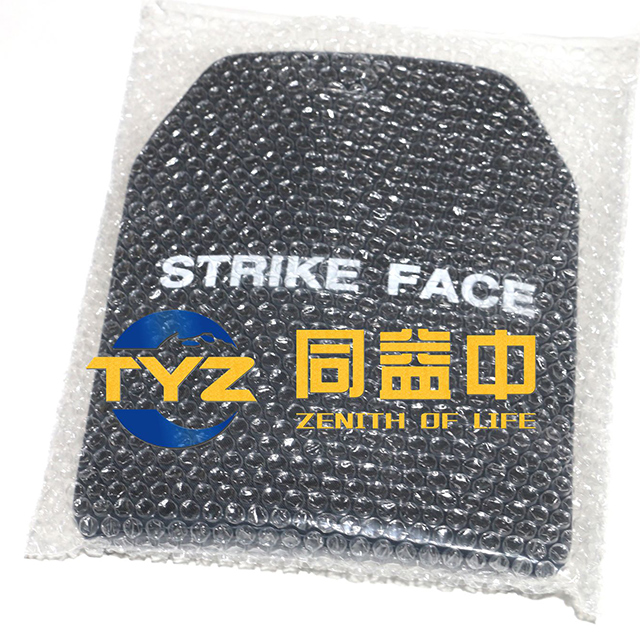
Ceramics operate through a "blunting and fracturing" process. The system features an extremely hard ceramic strike face bonded to a softer, tensile backing material. When an AP round hits the ceramic, the extreme hardness blunts the bullet tip. Simultaneously, the ceramic purposefully shatters. This localized shattering absorbs massive amounts of kinetic energy. The backing material then catches the resulting ceramic and bullet fragments.
Ceramic fundamentally changes how we approach high-tier threats.
Superior AP Defeat: Ceramic stops threats like the 7.62x51mm AP round. A steel plate capable of stopping this same round would be impractically thick and heavy.
Weight Efficiency: Ceramic systems weigh significantly less than steel for equivalent high-level threat protection. This makes it an ideal hard ballistic armor for preserving vehicle handling.
Ceramic systems demand careful handling and strategic placement due to their inherent brittleness.
Sacrificial Nature: Ceramic is explicitly designed to break upon impact. A localized area shatters to stop the bullet. Subsequent hits in the exact same location have a much higher probability of penetration.
Micro-Fracture Susceptibility: Severe off-road vibration, dropped panels, or physical strikes can create invisible micro-fractures in the ceramic matrix. Without proper padded housing and rigid mounting, non-ballistic impacts degrade the armor's integrity.
Higher Lifecycle Replacement: Once a ceramic panel sustains a ballistic strike, you must replace it. You cannot repair a shattered ceramic matrix.
Ultra-High-Molecular-Weight Polyethylene (UHMWPE) represents the pinnacle of lightweight ballistic technology. Manufacturers spin high-strength polymers into directional sheets, pressing them under immense heat and pressure to form rigid panels.
UHMWPE does not shatter bullets like steel or ceramic. Instead, it relies on a friction-based capture mechanism. As the bullet strikes the panel, it attempts to force its way through the dense polymer layers. The extreme rotation and kinetic heat of the bullet melt the polyethylene fibers. These melted fibers instantly grab the projectile, decelerating it. The material then rapidly cools, encapsulating the bullet completely within the panel.
Polyethylene changes the game for civilian and VIP transport vehicles.
Minimal Weight: UHMWPE is the lightest standalone hard armor available. It maximizes vehicle speed, preserves handling characteristics, and leaves ample room for passengers and cargo.
Environmental Resilience: Properly sealed UHMWPE panels resist water ingress, chemical degradation, and UV damage exceptionally well.
Zero Spall Risk: Because the material absorbs and captures the projectile internally, it poses absolutely no fragmentation or spall hazard to vehicle occupants.
You cannot use UHMWPE for every application. It possesses strict physical and thermal limitations.
Volume and Thickness: While incredibly light, stopping heavy rifle threats requires substantial material thickness. Integrating thick panels into standard commercial vehicle doors severely limits cabin space. It often requires custom window regulators and interior trim modifications.
Thermal Sensitivities: Polyethylene relies on a specific melting threshold to function. Exposing it to sustained extreme high temperatures degrades its ballistic performance. You must keep pure UHMWPE panels away from exhaust systems, engine blocks, and uninsulated firewalls.
Vulnerability to Pure AP: Pure UHMWPE struggles against specialized steel-core AP rounds. AP penetrators do not deform easily. They punch cleanly through the friction layers. Defeating AP threats with UHMWPE requires pairing it with a ceramic strike face.
Successful up-armoring rarely relies on a single material. Fleet managers achieve the best results by matching specific materials to distinct zones of the vehicle based on threat level and weight capacity.
Military and heavy law enforcement vehicles operate in visible, high-threat environments. Engineers design these chassis specifically to carry immense loads. Here, we recommend heavy reliance on steel and ceramic hybrids. Weight poses less of an issue. The priority is multi-hit capability against heavy machine guns and explosive fragmentation. Steel provides the structural tub, while ceramic plates defeat targeted AP strikes.
Covert vehicles must maintain a stock appearance. If an armored SUV looks visibly weighed down, it loses its tactical advantage. For these platforms, we recommend UHMWPE for door panels, roof armor, and floorboards. This preserves the factory suspension and acceleration. You then apply targeted ceramic plates strictly to critical zones where AP threats are most likely to strike, such as the direct passenger cabin sightlines.
Modern armorers achieve B6/B7 ratings by using composite hybrid systems. They back a hard ceramic strike face with a rigid UHMWPE spall liner. The ceramic shatters the AP core, and the UHMWPE catches all fragments while minimizing overall weight. This composite approach keeps commercial vehicles well under their maximum GVWR.
Vehicle Profile | Primary Material Focus | Key Application Zones | Expected Capability Goal |
|---|---|---|---|
Heavy Tactical (APC) | Steel + Ceramic Hybrids | Chassis, Hull, External Panels | Extreme multi-hit, Heavy AP defeat, Blast resistance |
Covert VIP (SUV) | UHMWPE | Doors, Roof, Floor, Firewalls | Preserve GVWR, High mobility, Handgun to standard rifle |
High-Threat Covert | Ceramic Strike Face + PE Backing | Direct sightlines, B-Pillars | AP rifle defeat under commercial weight limits |
Before committing to a material, thoroughly audit your fleet's GVWR limits. Weigh your vehicles fully loaded with personnel and gear. Calculate your exact available payload. Then, demand multi-hit testing data from your armor providers. Specifically ask for V50 ballistic limit testing reports to ensure the material performs reliably at the velocities you expect to encounter.
No single ballistic material acts as a flawless shield. Material selection always demands a calculated compromise between weight, cost, and absolute protection levels.
Prioritizing vehicle mobility is a proven survival tactic. Over-armoring a standard commercial chassis with thick steel creates a stationary target the moment the overloaded transmission fails. You must maintain the ability to drive off the X during an ambush.
To finalize your strategy, consult with a certified armoring engineer. They will conduct a comprehensive threat-to-payload analysis tailored to your specific operational theater. By matching the physics of the armor to the mechanics of your vehicle, you ensure maximum survivability for your personnel.
A: Steel effectively outlasts the vehicle itself, assuming anti-rust coatings remain intact. However, UHMWPE and ceramic matrices typically carry 5-to-10-year warranties. Their exact lifespan depends heavily on environmental exposure, humidity, heat cycling, and the manufacturer's specific bonding techniques.
A: Pure UHMWPE struggles against AP penetrators because the hardened steel or tungsten cores do not deform upon impact. They punch through the polymer layers. To stop AP threats, you must pair the UHMWPE backing with a hard ceramic or high-hard steel strike face.
A: Spall refers to the lethal fragmentation of a bullet upon striking a hardened steel plate. The bullet shatters outward at high velocities. Anti-spall coatings, typically thick polyurea, capture these fragments instantly upon impact. This prevents the metal shards from rebounding into the cabin and causing severe occupant injury.