
 English
Views: 0 Author: Site Editor Publish Time: 2026-09-22 Origin: Site


A dangerous assumption persists across the personal protection industry. Many people assume any tactical vest provides a universal shield against all weapons. This critical misconception often leads to catastrophic field failures. Wearing the wrong armor type leaves users completely exposed to specific, deadly dangers. For example, trusting standard soft armor against a microscopic spike threat yields fatal results.
This article provides an evidence-based framework for evaluating your unique operational risks. We will explore distinct material mechanisms, review specific testing standards, and guide you toward the correct protective equipment. Procurement managers, law enforcement officers, and private security teams will learn exactly how to match their gear to real-world threats. By analyzing these variables, you ensure optimal safety without compromising daily mobility.
Threat Mechanics Differ: Ballistic armor disperses high-velocity kinetic energy; a stab-resistant vest prevents low-velocity fiber separation and puncturing.
Materials Matter: Kevlar and UHMWPE behave differently depending on how they are woven or laminated; standard ballistic vests offer little to no protection against edged or spiked weapons.
Distinct Certifications: Authentic body armor must be evaluated against specific, separate NIJ (National Institute of Justice) standards for ballistics (NIJ 0101.06/07) and stab/spike threats (NIJ 0115.00).
Hybrid Trade-offs: Multi-threat armor exists but requires careful evaluation of weight, flexibility, and cost trade-offs.
Before purchasing protective equipment, you must define the operational environment. Different professions face statistically different risks. We must solve the business problem by identifying exactly what threats your personnel encounter daily. Emergency Medical Services (EMS) personnel and corrections officers face higher edged-weapon risks. Their environments involve close quarters and improvised weapons. Conversely, patrol officers encounter much higher ballistic risks on the streets.
Understanding these distinct environments helps you select the correct Body Armor. You cannot optimize protection without first analyzing the daily reality of the end-user.
Threats fall into two primary categories based on velocity and energy delivery. They behave entirely differently upon impact.
Firearms generate high-velocity threats. Bullets carry massive kinetic energy. They deliver rapid impact over a small surface area. This rapid energy transfer causes blunt force trauma. It also destroys tissue through temporary cavitation. The goal of armor here is rapid energy absorption.
Edged and spiked weapons act differently. Knives, needles, and ice picks represent low-velocity threats. They rely on human mechanics rather than explosive propulsion. However, they apply highly concentrated pressure onto a microscopic point. They are designed to part material fibers and penetrate deeply. They slice or slip through materials rather than smashing them.
A dangerous myth suggests high-level armor stops lower-level threats universally. This is factually incorrect. A Level IIIA ballistic vest expertly stops a .44 Magnum round. Yet, it will fail miserably against a simple ice pick. The loose weave allows the fine point to slip between the fibers.
The inverse is also true. A dedicated stab-resistant vest easily halts a heavy knife strike. However, it will fail against a 9mm round. It lacks the sheer tensile strength and energy dispersion properties required to catch a speeding bullet. You cannot cross-apply these protections safely.
Modern armor relies on advanced material science. Engineers manipulate synthetic fibers to defeat specific physical forces. How a material is woven, layered, or laminated dictates its ultimate capability.
Ballistic panels function like high-tech nets. Manufacturers typically use woven aramid fibers, like Kevlar, or Ultra-High-Molecular-Weight Polyethylene (UHMWPE). When a bullet strikes the panel, these strong fibers "catch" the projectile. They stretch and disperse the kinetic energy across the entire panel surface. This rapid spreading of energy decelerates the bullet until it stops.
Stopping the bullet is only half the battle. Deformation is a major concern. When the armor catches the bullet, the panel dents inward toward the body. This is called backface signature. Excessive backface signature causes lethal blunt force trauma. It can break ribs or rupture internal organs. Quality ballistic panels minimize this inward denting. They ensure the user survives both the penetration and the impact shock.
Stab threats require a completely different engineering approach. Edged weapons defeat standard woven fibers by slicing them or pushing them aside. Therefore, stab panels prioritize friction and deflection over energy absorption.
Engineers use tightly woven fibers and laminated Kevlar to create high friction. Some heavy-duty variants incorporate metallic components like chainmail or rigid composite plates. This construction stops a sharp edge from sliding between the material weaves. By halting fiber separation, the panel stops the blade or spike before it ever reaches the user's body.
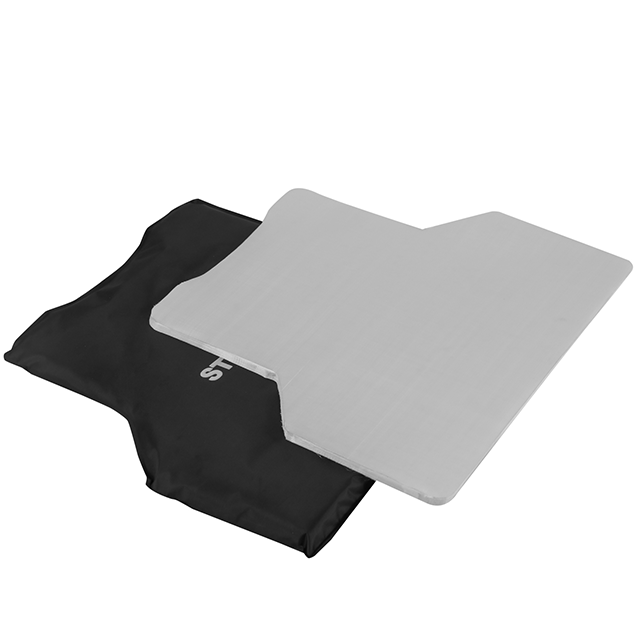
Evaluating armor claims requires understanding the National Institute of Justice (NIJ) standards. The NIJ provides the benchmark for testing and certifying protective equipment. Relying on these independent standards removes the guesswork from procurement.
NIJ Protection Standards Overview
Threat Type | Relevant NIJ Standard | Primary Protection Mechanism | Common Example Threats |
|---|---|---|---|
Ballistic (Firearms) | NIJ 0101.06 / 0101.07 | Kinetic Energy Dispersion | 9mm, .44 Magnum, 5.56mm Rifle |
Edged Blade | NIJ 0115.00 | Cutting Resistance / Friction | Commercial Knives, Machetes |
Spike | NIJ 0115.00 (Spike Class) | Puncture Resistance / Deflection | Ice Picks, Needles, Improvised Shanks |
The NIJ 0101.06 standard (and the newer 0101.07 standard) dictates ballistic testing protocols. They divide armor into distinct threat levels.
Soft armor encompasses Level IIA, Level II, and Level IIIA. These flexible panels stop handgun rounds. Level IIIA offers the highest soft armor protection, defeating .357 SIG and .44 Magnum rounds. Hard armor includes Level III and Level IV plates. These rigid plates stop rifle fire, including armor-piercing ammunition.
The testing criteria are rigorous. Laboratories test panels based on bullet caliber, bullet mass, and impact velocity. They also measure backface deformation strictly. The denting cannot exceed 44 millimeters into the backing clay. If it fails any metric, it fails the certification entirely.
For low-velocity threats, the NIJ utilizes the 0115.00 standard. This standard recognizes two very different threat profiles: Edged Blade and Spike.
Edged Blade testing simulates attacks from commercial knives. These weapons cut fibers. Spike testing simulates attacks from ice picks and needles. These weapons slip through microscopic gaps. Armor can pass the blade test but fail the spike test.
The standard establishes three energy levels (Level 1, 2, and 3). These levels represent the joules of force applied by a mechanical drop mass during testing. Level 1 protects against typical concealed threats. Level 3 protects against extreme, high-energy strikes found in riot conditions.
Marketing terms often mislead buyers. The phrase "tested to NIJ standards" is entirely different from "NIJ Certified." Any company can test a product internally and claim success. However, true certification requires independent lab validation.
You must verify claims actively. Always check the official NIJ Compliant Products List (CPL). If a vest does not appear on the active CPL, it lacks verified certification. Never trust unverified marketing language when lives are at stake.
In unpredictable environments, professionals sometimes need protection against multiple threat categories simultaneously. This necessity led to the development of hybrid systems.
Multi-threat armor integrates different material technologies into a single panel system. These vests are specifically engineered to meet both NIJ 0101.06 ballistic standards and NIJ 0115.00 stab/spike standards simultaneously. They usually layer woven Kevlar for ballistics alongside laminated synthetics for puncture resistance.
Choosing multi-threat gear involves significant operational trade-offs. You must balance the benefits against the physical drawbacks.
Pros: They provide incredible versatility. First responders and corrections officers face unpredictable, chaotic environments. A multi-threat vest ensures protection regardless of the weapon deployed by an attacker.
Cons: Hybrid panels carry a weight penalty. Adding protective layers increases the overall bulk. This reduces user flexibility and comfort. A heavier, stiffer vest causes rapid physical fatigue during a long shift. Furthermore, manufacturing these complex layers increases initial procurement expenses.
Outfitting an entire agency in multi-threat gear requires strategic planning. You must ask if this approach is truly viable for every team member. Often, tailoring armor types to specific departmental roles makes more sense. Administrators might need basic ballistic soft armor. Extraction teams might require rigid Level III plates. Corrections staff might only need spike-rated gear. Targeted procurement often yields better compliance and operational efficiency.
Selecting protective gear is a structured process. Use this framework to evaluate your options systematically.
Step 1: Conduct a Threat Assessment: Analyze your historical incident data. Is the primary daily threat bullets, blades, or improvised spikes? Do not buy based on fear; buy based on statistical reality.
Step 2: Balance Protection with Mobility: Determine the maximum acceptable weight for your personnel. Heavier armor causes rapid fatigue. Discomfort reduces the likelihood of daily adoption. The absolute best armor is the one your team actually wears.
Step 3: Verify Certifications: Demand independent laboratory reports. Cross-reference the model number with active NIJ compliance documentation on the official CPL. Accept no substitutes or vague marketing claims.
Step 4: Assess Lifecycle and Maintenance: Factor in carrier durability and replacement cycles. Soft ballistic and stab panels typically carry a standard five-year warranty. Materials degrade over time due to sweat, heat, and structural wear. Plan your replacement cycles accordingly to maintain maximum safety margins.
Selecting personal protective equipment is a critical, life-or-death calculation. It requires precise alignment with specific physical threats, entirely dispelling the myth of a one-size-fits-all purchase. High-velocity bullets require energy dispersion, while low-velocity spikes demand material deflection. You cannot mix these operational realities safely.
We reiterate the strict necessity of matching material science and NIJ ratings directly to your field environment. Misunderstanding these ratings leaves personnel vulnerable.
We strongly recommend taking action immediately. Consult with a dedicated armor specialist today. Audit your current active gear, review your departmental threat profiles rigorously, and request detailed specifications for properly certified ballistic or stab-resistant vests. Ensure your team enters the field fully protected.
A: No. Stab vests completely lack the energy dispersion properties required to stop high-velocity projectiles. While they stop blades via friction and tightly woven layers, a speeding bullet will easily punch through these materials, causing lethal trauma. You must use certified ballistic panels to stop firearms.
A: Patrol officers primarily wear ballistic vests, as firearms represent their highest statistical threat on the street. However, some tactical response teams or correctional units utilize multi-threat or strictly stab-resistant variants. Their specific deployment environment dictates the precise armor configuration they wear daily.
A: The industry standard warranty for soft ballistic and stab panels is five years. Over time, protective materials naturally degrade. Daily exposure to body heat, moisture, ultraviolet light, and physical folding weakens the synthetic fibers. You must replace panels after five years to guarantee certified protection levels.
A: Blades and spikes attack materials differently. Edged blades attempt to cut and slice through fibers. Spikes, like needles or ice picks, slip through microscopic gaps between weaves without cutting. Armor must be specifically engineered and NIJ-rated for spikes to stop these puncturing threats.